DeepBayes Lab
We are a probabilistic machine learning group within the Australian Artificial Intelligence Institute at University of Technology Sydney in Australia, focusing on the interplay between Bayesian inference and deep learning. Our goal is to enhance the reliability, robustness, data efficiency, and uncertainty estimation of modern machine learning methods.
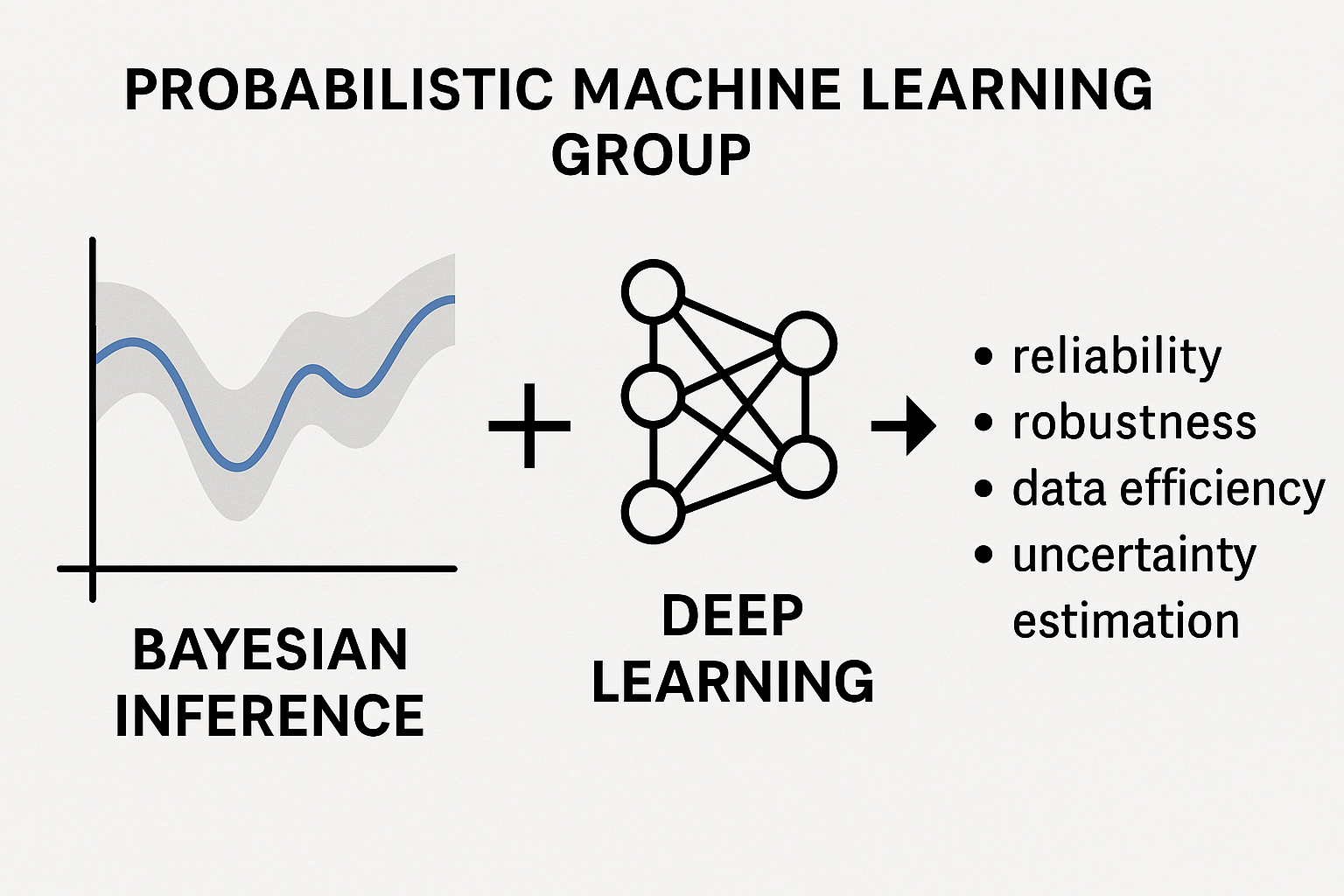
While deep learning has transformed countless domains, it often lacks calibrated uncertainty and depends heavily on large volumes of labeled data. In contrast, probabilistic machine learning offers a principled framework for modeling uncertainty, incorporating prior knowledge, and making robust, data-efficient decisions. This is especially critical in safty-critical and scientific applications, where interpretability is essential and data is often scarce.
We believe the true goal of machine learning is not merely to produce accurate predictions, but to enable reliable decision-making under uncertainty. Probabilistic approaches empower models to reason about what they don’t know, leading to safer and more informed outcomes in high-stakes environments.
Our research focuses on foundational challenges in probabilistic machine learning. We explore how uncertainty can be effectively represented and reasoned about in deep learning models, and how classical architectures can be enhanced through uncertainty-aware mechanisms. We investigate efficient strategies for sampling and inference in high-dimensional probabilistic spaces, and seek to unify generative and discriminative paradigms under coherent probabilistic frameworks. We also study the theoretical principles that govern the trade-offs between model expressiveness, uncertainty quantification, and generalization performance.
Our mission is to advance probabilistic machine learning as the default paradigm for reliable and data-efficient AI. Achieving this vision requires developing new theoretical foundations, scalable and practical algorithms, and working closely with domain experts to ensure our methods address real-world challenges.